Earning Trust in AI Predictions
full ux case study link
Background and context
Crunchbase introduced new AI data within Company Profiles, including Predictions & Insights, Growth Scores, and Heat Scores. At launch, we provided supporting context to help users understand and evaluate individual predictions. Post-launch research revealed broader trust needs: clearer explanations of scores, evidence of model reliability, and ways to flag inaccurate information. This project focused on defining and applying a trust and transparency framework to help users understand, evaluate, and confidently act on Crunchbase’s AI data.
In response, I developed a framework for building trust across Predictions & Insights. The framework informed several post-launch features, each addressing a different aspect of trust and transparency:
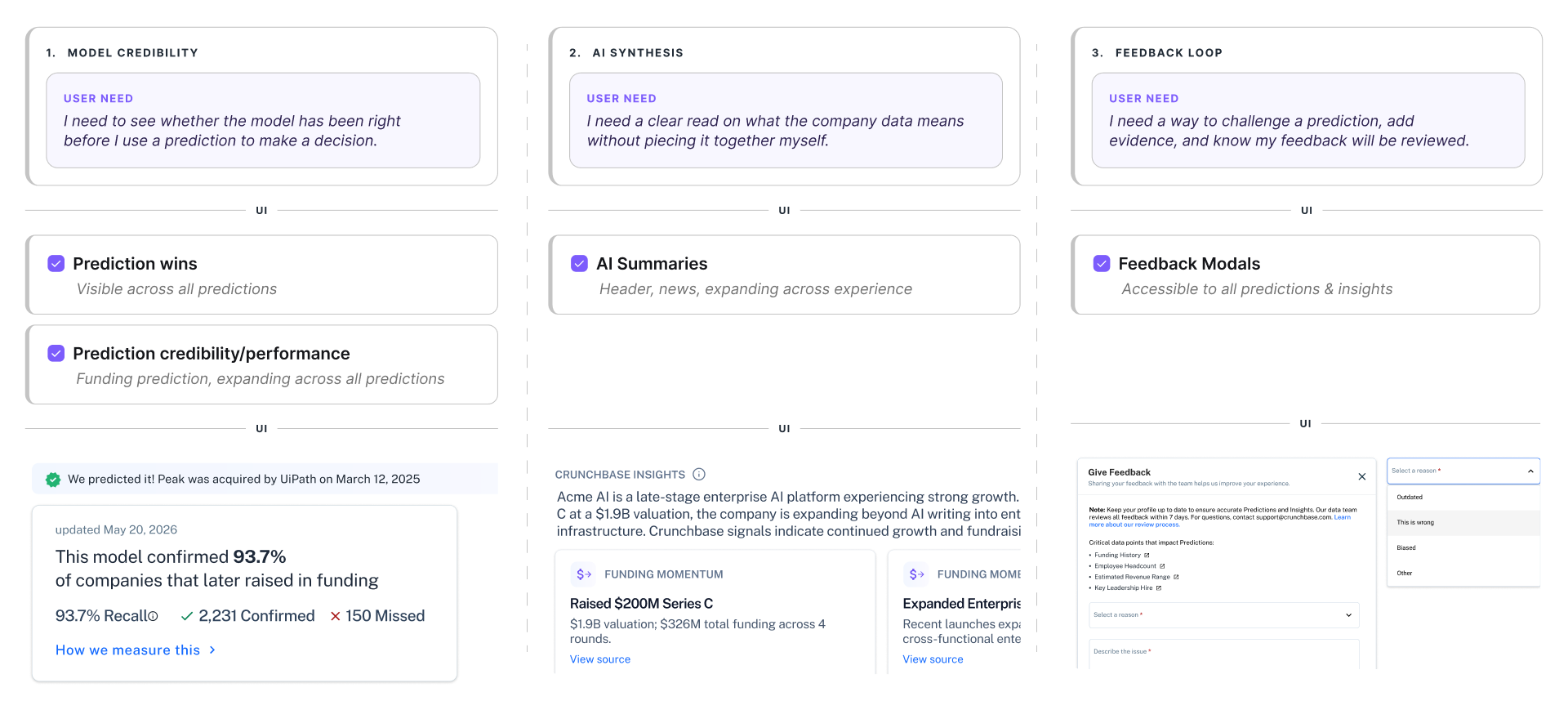
1. Prediction Credibility UI: Surfaces historical model performance metrics so users can evaluate the reliability of Crunchbase predictions.
2. Win Predictions: Surfaces fixed events that Crunchbase correctly predicted, providing real-world evidence of model performance.
3. AI-Powered Company Header and Contextual Summaries: Introduces AI-generated intelligence at the top of the profile, with supporting sources and additional considerations around how AI-generated information is presented and explained.
4. P&I Feedback Modals: Gives users a direct path to flag inaccurate information and helps close the loop between user feedback and model quality over time.
My role
I was the Lead Product Designer for the post-launch evolution of Predictions & Insights, partnering with Product, Engineering, Data Science, Sales, and Sales Engineering. I defined the trust and transparency framework, designed the user experience for model performance, evidence, grounding, and feedback, and translated post-launch research into product improvements. The work required balancing user needs, model capabilities, and business priorities to determine what evidence could be surfaced responsibly and how credibility could be communicated throughout the experience.
The problem: the product explained the prediction, not its reliability
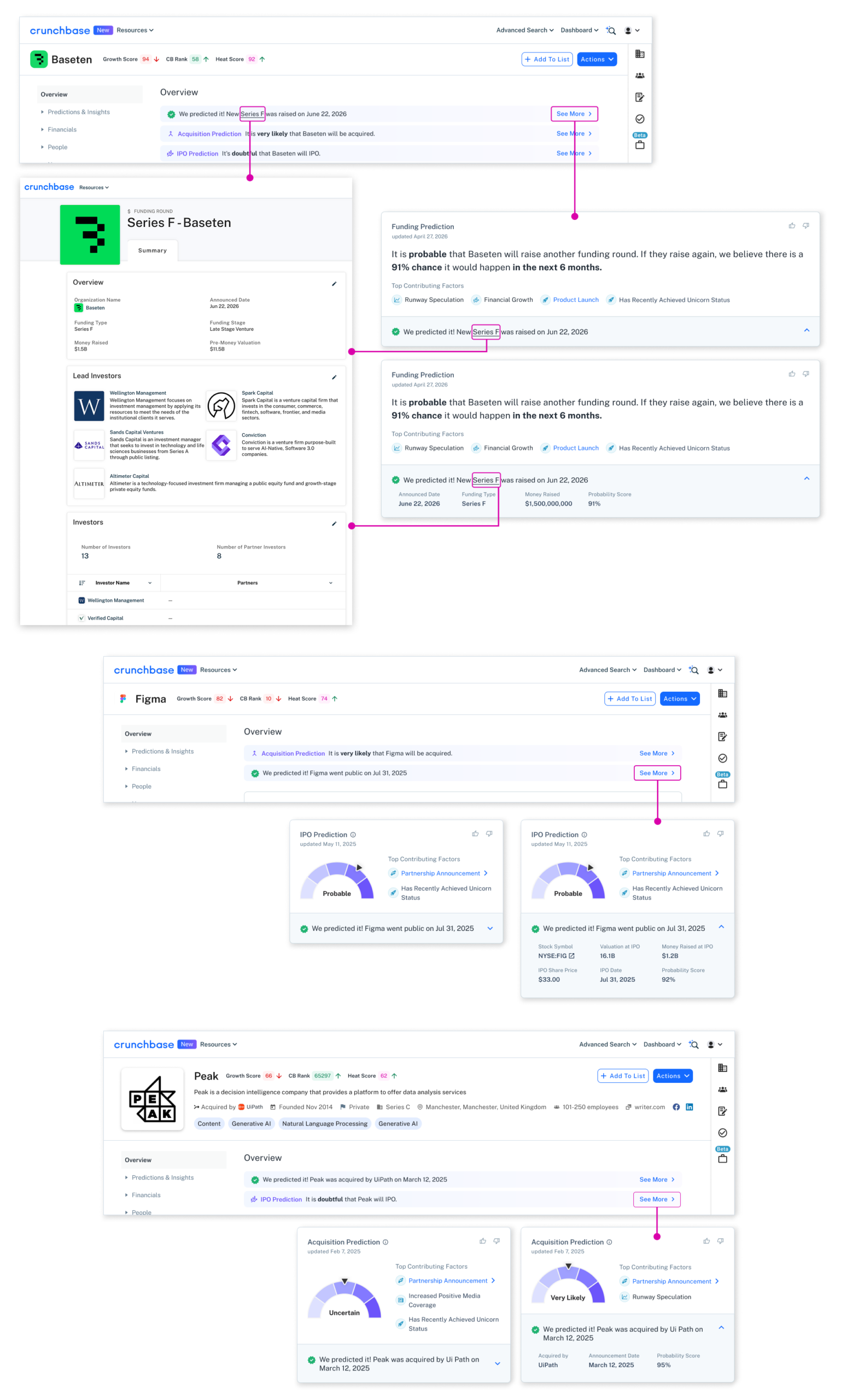
Users understood what the prediction was forecasting, but lacked the evidence needed to evaluate the model behind it. Predictions included supporting context, but nothing about historical performance, confirmed outcomes, or track record. Users could inspect the prediction, but not assess its reliability.
Data Analytics had built a Live Predictions Dashboard that Sales and Sales Engineering used on customer calls to demonstrate model accuracy, and it was effective at converting prospects and supporting renewals. None of that evidence existed in the product itself. Self-serve users saw the same predictions without the track record behind them. The opportunity was to bring that evidence into the product experience, where it could build trust at scale rather than one call at a time.
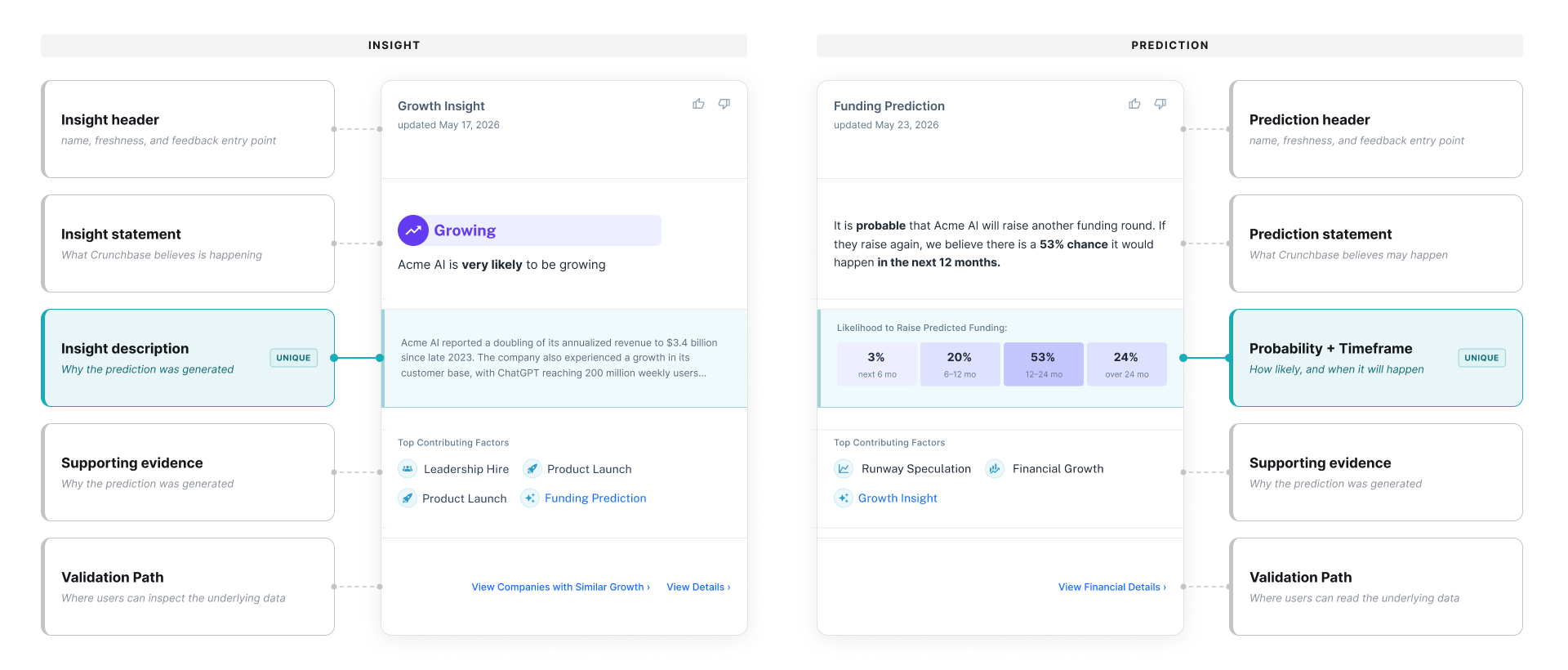
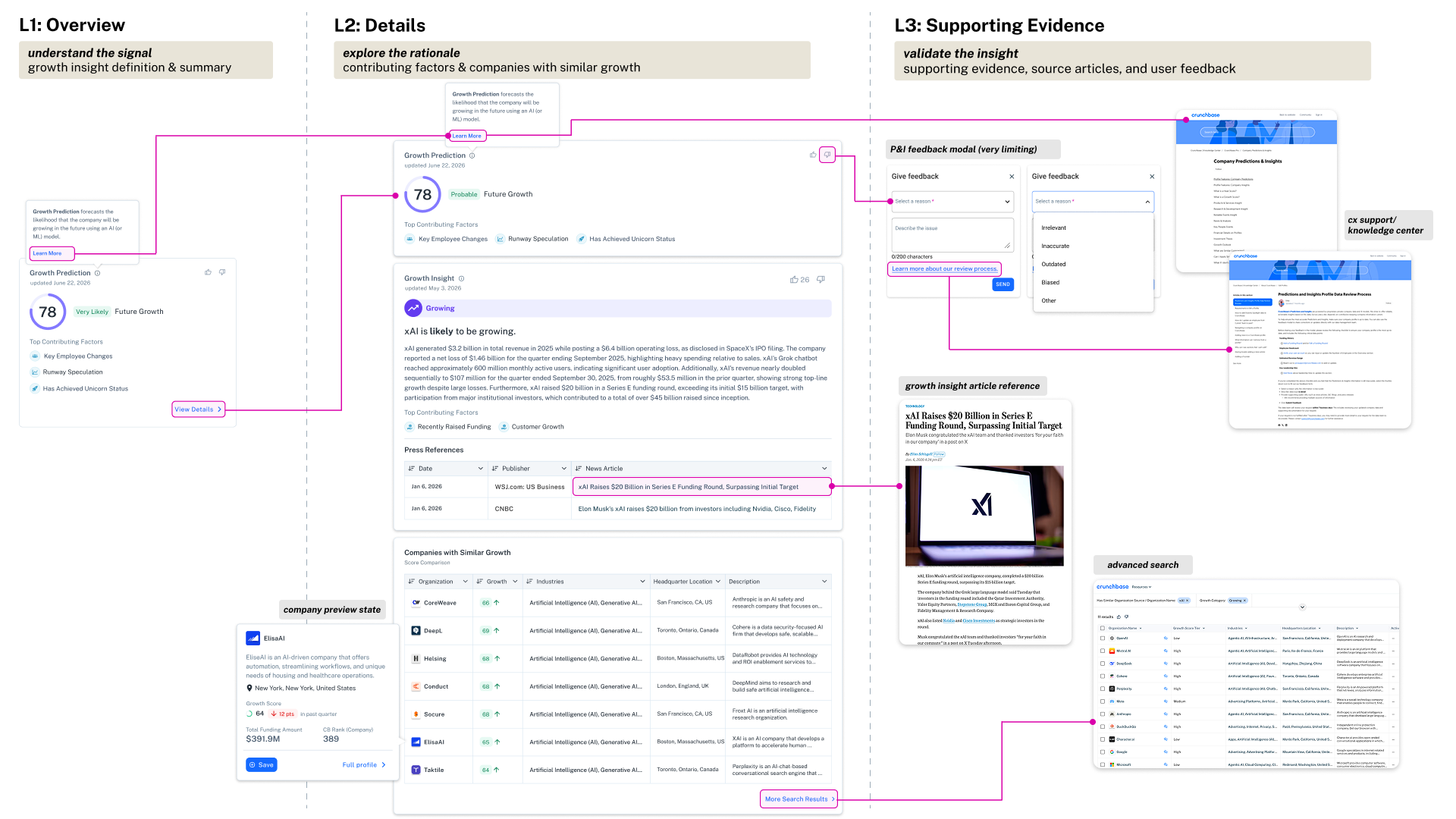
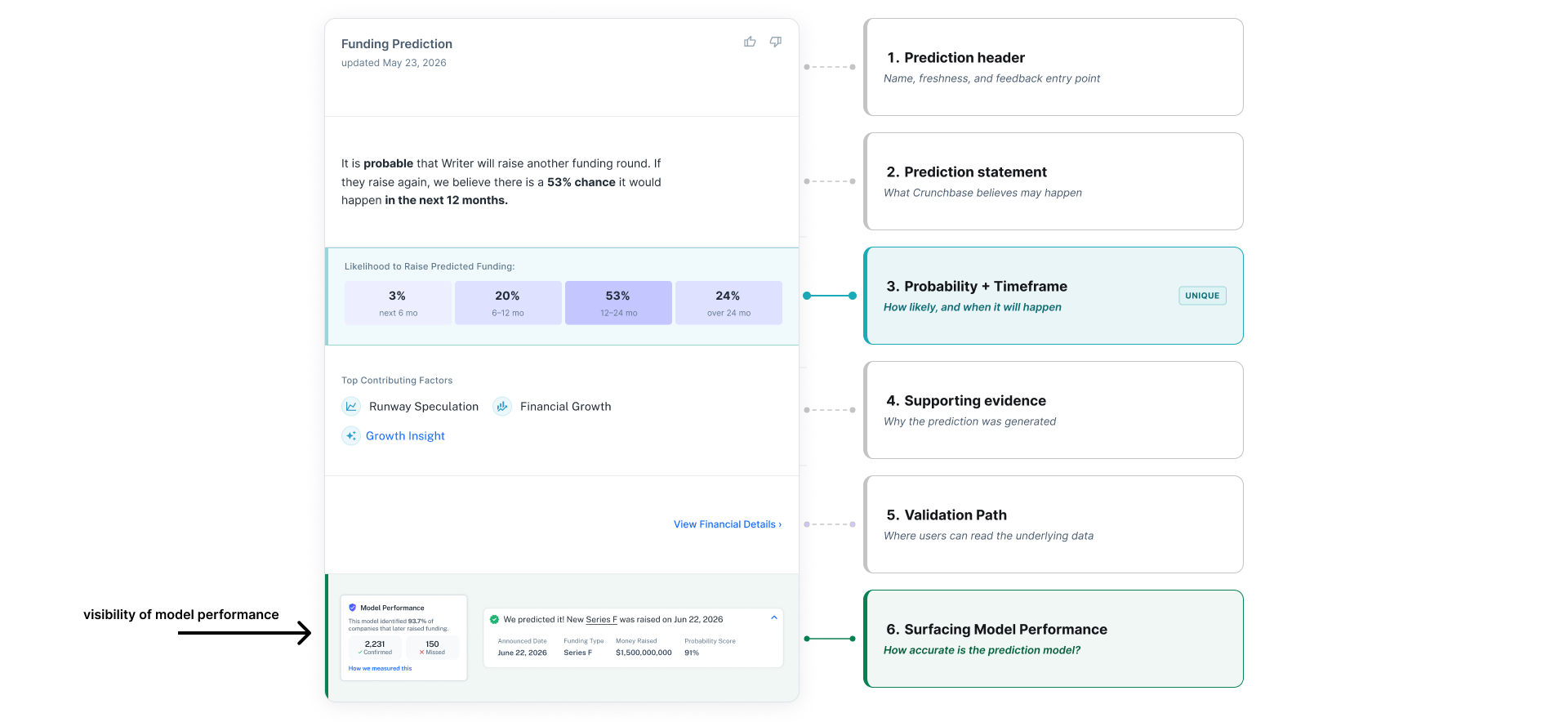
The diagrams below illustrate the Prediction & Insight IA, along with their drill down pathways:
Post-launch research:
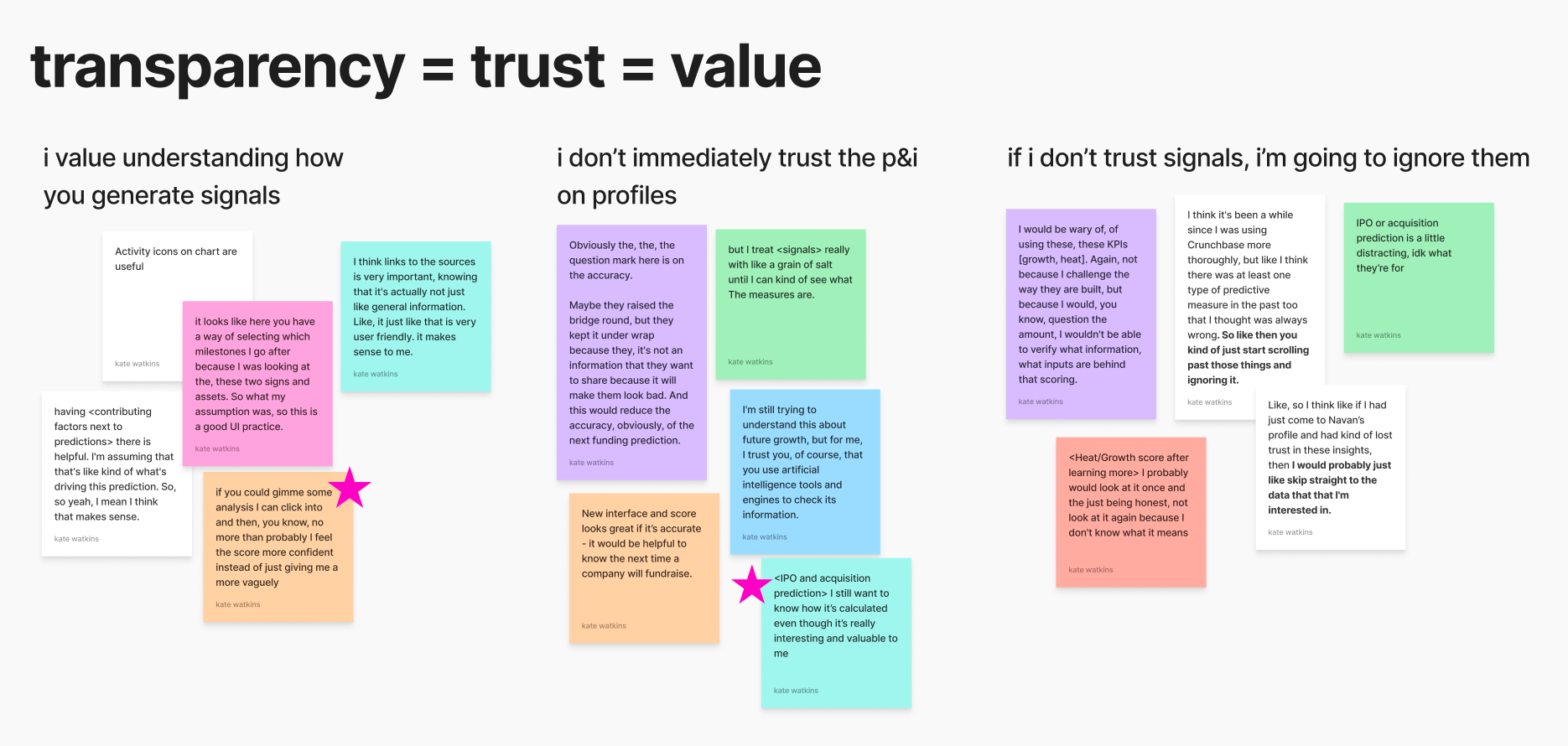
Users felt the profile experience had improved, and Predictions & Insights helped them form a company narrative. However, they still had to sift through substantial data to assess overall performance. They wanted high-level summaries at the top of the page to make Crunchbase’s interpretation clearer and save time.
Predictive data also needed stronger credibility cues. The same questions came up repeatedly: “What data drove it?” and “Has it been right before?” Users wanted clearer ways to challenge inaccurate predictions or scores and provide evidence to support corrections.
Separately, Data Analytics had built a Live Predictions Dashboard that Sales and Sales Engineering used to demonstrate model accuracy, helping convert prospects and support renewals. That evidence was absent from the product, leaving self-serve users without a visible track record. Bringing it into profiles offered a way to build trust at scale.
Together, these findings shaped the next wave of work: tailored feedback modals, Prediction Credibility UI, Prediction Win banners, AI Overview, and AI contextual summaries.
A system for building trust
Trust in AI requires a system of product levers that let users evaluate the prediction, validate the model, challenge the output, and decide what to do next. Below is the framework we used to instill trust in Predictions and Insights:
Surfacing model accuracy
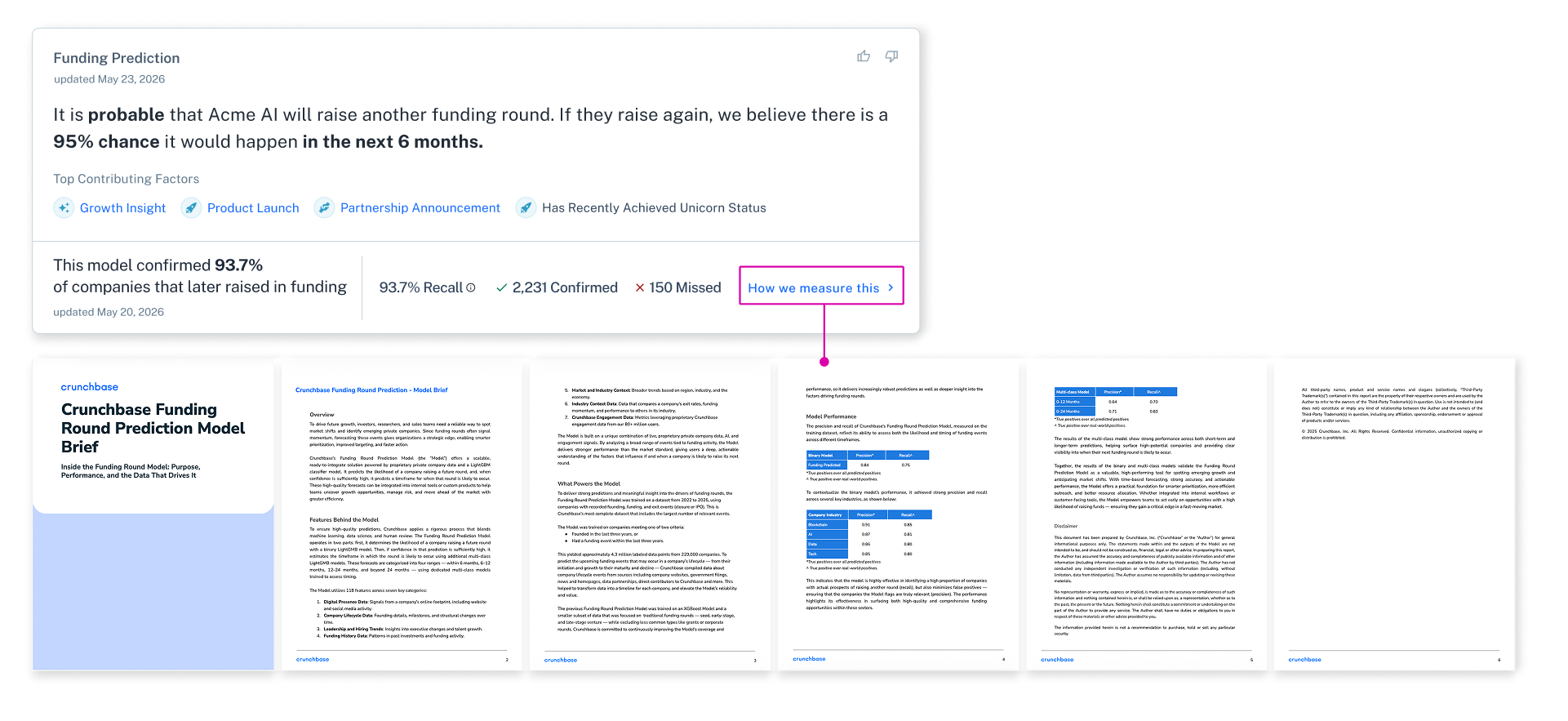
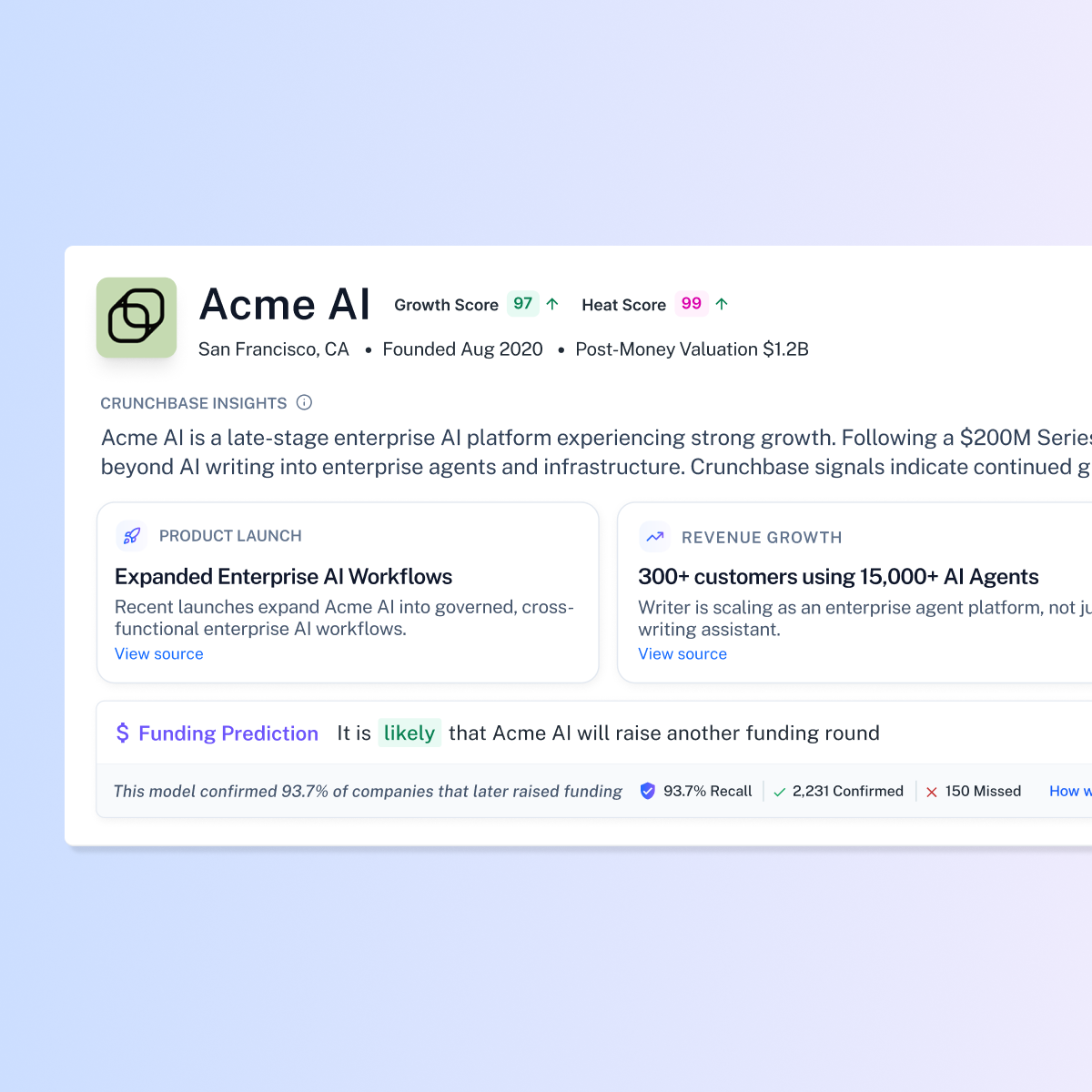
Prediction Credibility UI made model performance visible in the product. Rather than showing only the prediction claim, the UI surfaced scoped performance data — 93.7% recall for a Funding Prediction segment, with 2,231 confirmed and 150 missed predictions — so users could judge whether Crunchbase had been reliable in a relevant context. The design challenge was translating model behavior into a credibility cue that non-technical users could read: every metric had to be clear, scoped, and carefully worded, without oversimplifying what it measured.
Prediction Wins; Fixed Events
Performance metrics are useful but somewhat abstract. Confirmed outcomes are concrete. Prediction Win banners surfaced moments where Crunchbase predicted an event that later happened — when a funding round, acquisition, or IPO was confirmed, the outcome appeared directly on the card. The banner did not explain the model. It proved the model had been right before.
Improved P&I feedback modals
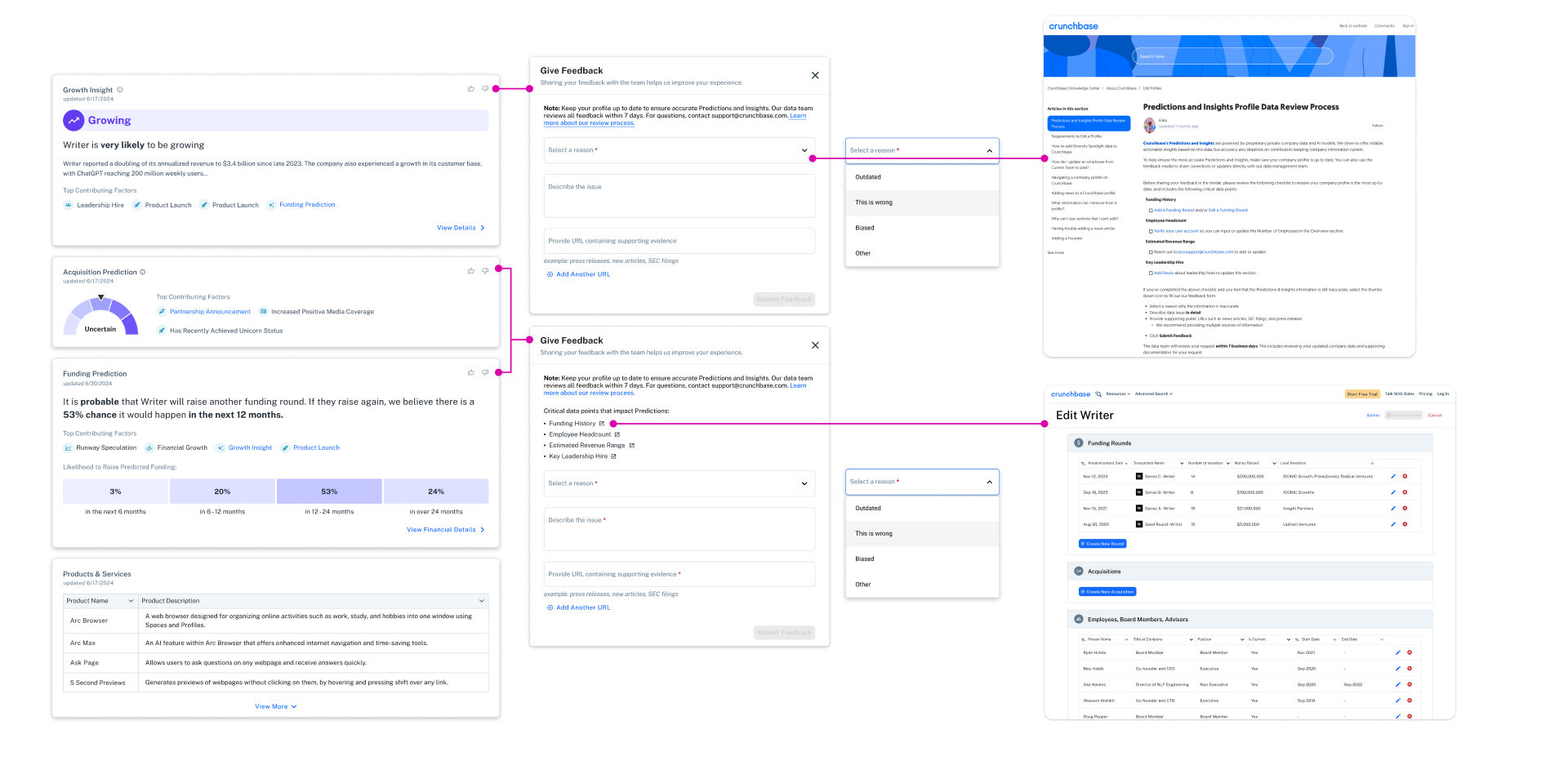
At launch, Predictions and Insights shared one general feedback path. Users could select a reason, but the modal collected too little context to make feedback actionable. Post-launch, we designed tailored feedback paths for each. The revised modal added a description field, a supporting-evidence URL, an explanation of the review process, and prediction-specific context around data points that could affect the model, such as funding history, employee headcount, estimated revenue range, and key leadership hires. This turned feedback from a support channel into part of the credibility system: users who disagreed with a prediction could challenge it and supply better evidence.
Improved P&I feedback modals
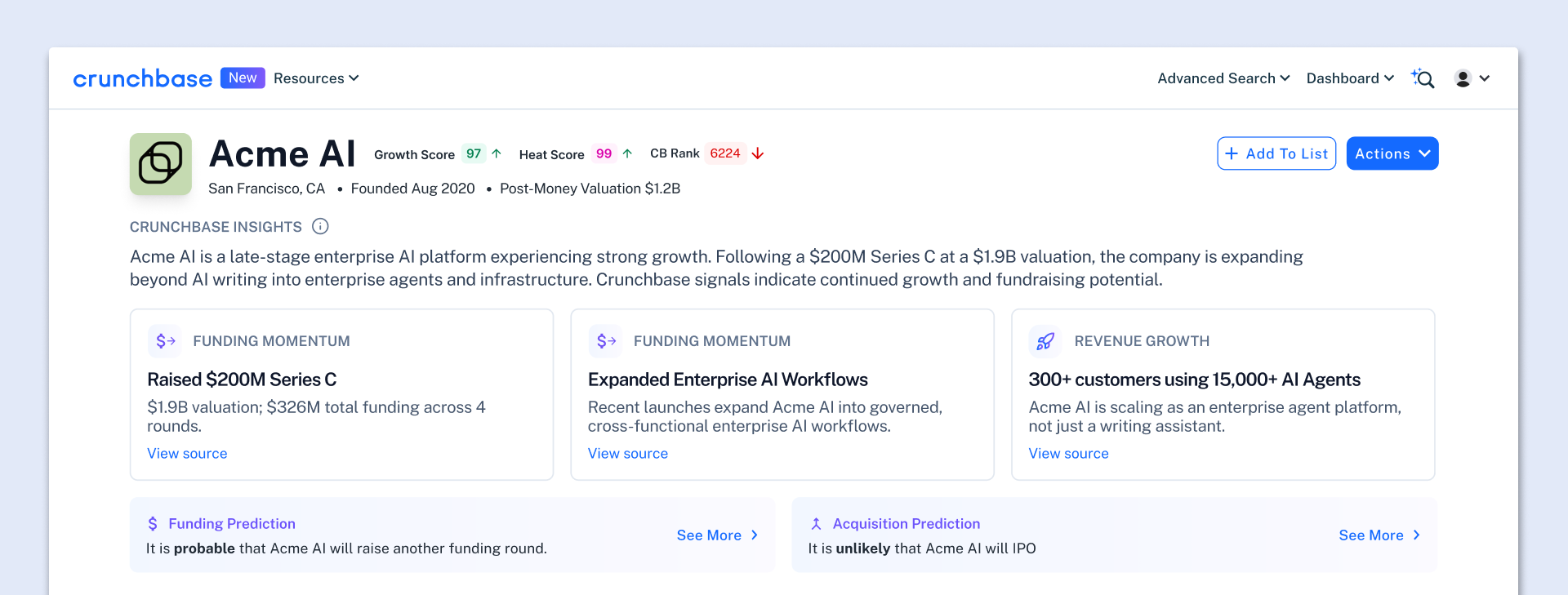
The credibility work extended beyond prediction cards. Users needed help forming a point of view without assembling it themselves, so we introduced an AI-generated company summary in the header. The governing principle: AI can summarize, but trust comes from grounding. Every summary had to connect back to visible source data, so the overview read as synthesis of the profile rather than unsupported AI text. The same pattern extended to contextual summaries for News and Competitor data.
Impact and current status
The work created a credibility system that now extends across multiple product surfaces. At launch, predictions were understandable but not yet credible. The follow-up work built the missing trust layer: model performance, confirmed outcomes, structured feedback, and grounded AI summaries.
Selected Works

Crunchbase AI ProfilesProduct Design

Crunchbase SearchProduct Design
Crunchbase Prediction CredibilityProduct Design
Cheddar + News12 CMSProduct Design
Pinterest Place PinsUI / UX
Crunchbase Chrome ExtensionProduct Design
News12 Web & App ExperienceProduct Design
Audubon Climate ReportUI / UX
Cheddar Content PersonalizationProduct Design
Cheddar tvOS experienceProduct Design
Body Metrics, Tech MuseumExperience Design
Little ShadowsMFA Design +Technology Thesis
DSI TableParsons
Midi TypewriterParsons MFA D+T
Algorithmic AnimationOpenframeworks

John WhitneyOpenframeworks
IllustrationProject type